Foreman
NewAsk an AI to watch security footage for hazards and it finds them everywhere, because that is what you asked about.
Civic data
our siloed NYC building-safety databases joined into one ranked inspection queue, tested against a fire that had already happened.
n 2022 a fire at the Twin Parks apartments in the Bronx killed 17 people. The doors that should have self-closed had been cited as violations years earlier, but those signals lived in separate city databases that never spoke to each other. FireSight asks a blunt question: if the data already existed, could the right building have been inspected first?
Four NYC Open Data sources were joined into a single ontology, then scored 0–100 on self-closing-door violations, complaint history and building age. Every input stays visible and weighted rather than hidden behind a model, because an inspection queue a supervisor cannot argue with is one they will not use.
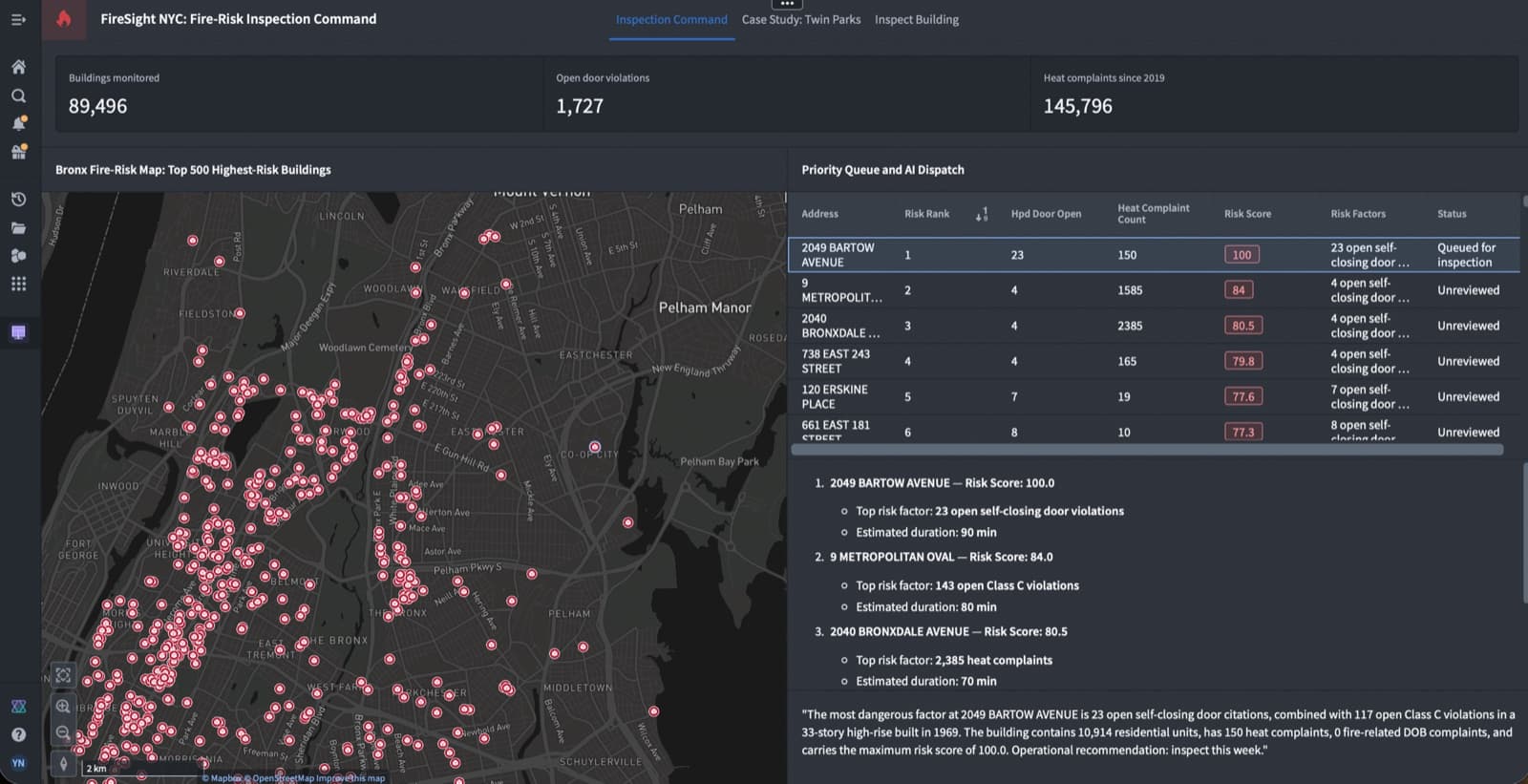
sing only data available before the fire, the model ranked Twin Parks #1,003 of 89,496 Bronx parcels. That is the top 1.1%.
It also means 1,002 buildings ranked ahead of it. Top 1.1% is a real signal on a queue nobody was running, not a bullseye, and anyone evaluating this should hold it to that standard.
black-box ranking is one a supervisor cannot argue with, and an inspection queue nobody can argue with is one nobody will use. Every input stays visible and weighted: open violations, how many of them are the self-closing-door kind, complaint density per unit, building age against the sprinkler mandate. A dispatcher can look at any building and see exactly which factors put it where it is.
The claim is that the system would have put Twin Parks at the top of the queue, not that it would have prevented the fire. Those are different sentences and only one of them is true.
What the project does demonstrate is the same instinct as everything else here: a scoring model proposes an order, a transparent set of inputs lets a human verify it, and a backtest against a known outcome is the only thing that makes either trustworthy.
Ask an AI to watch security footage for hazards and it finds them everywhere, because that is what you asked about.
The rest of it, and what each one cost.
A thing I built for myself that has been running unattended on my laptop since July.